The MONOCAB Project
MONOCAB offers an innovative and cost-effective way to reactivate disused railway lines while simultaneously closing mobility gaps in rural areas.
Realization of the Project
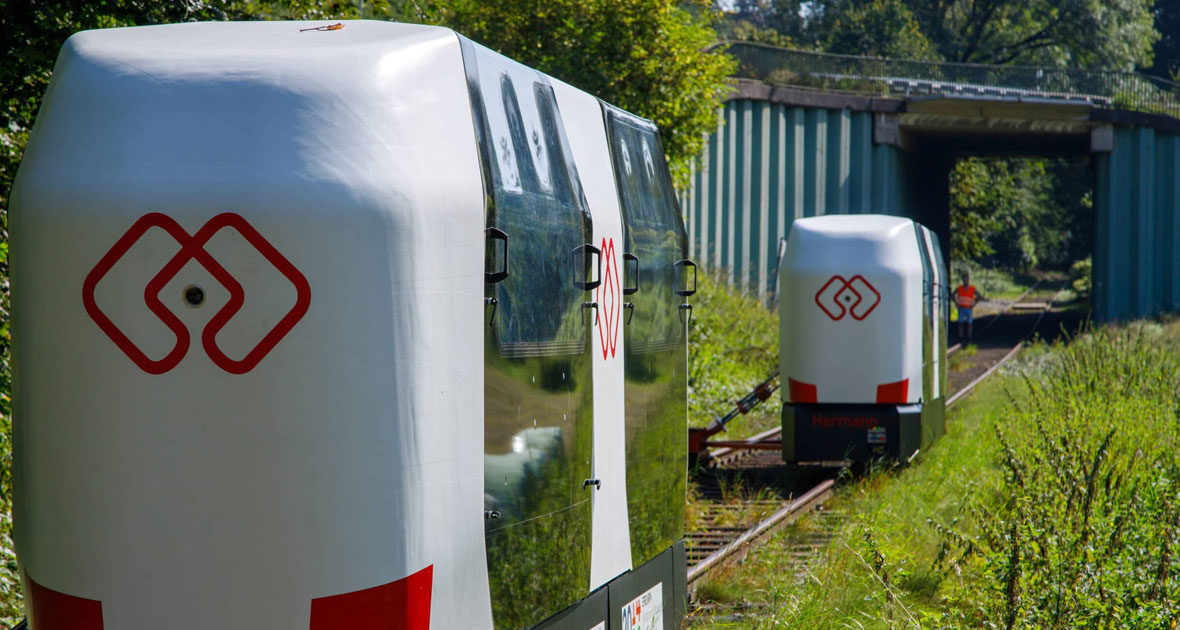
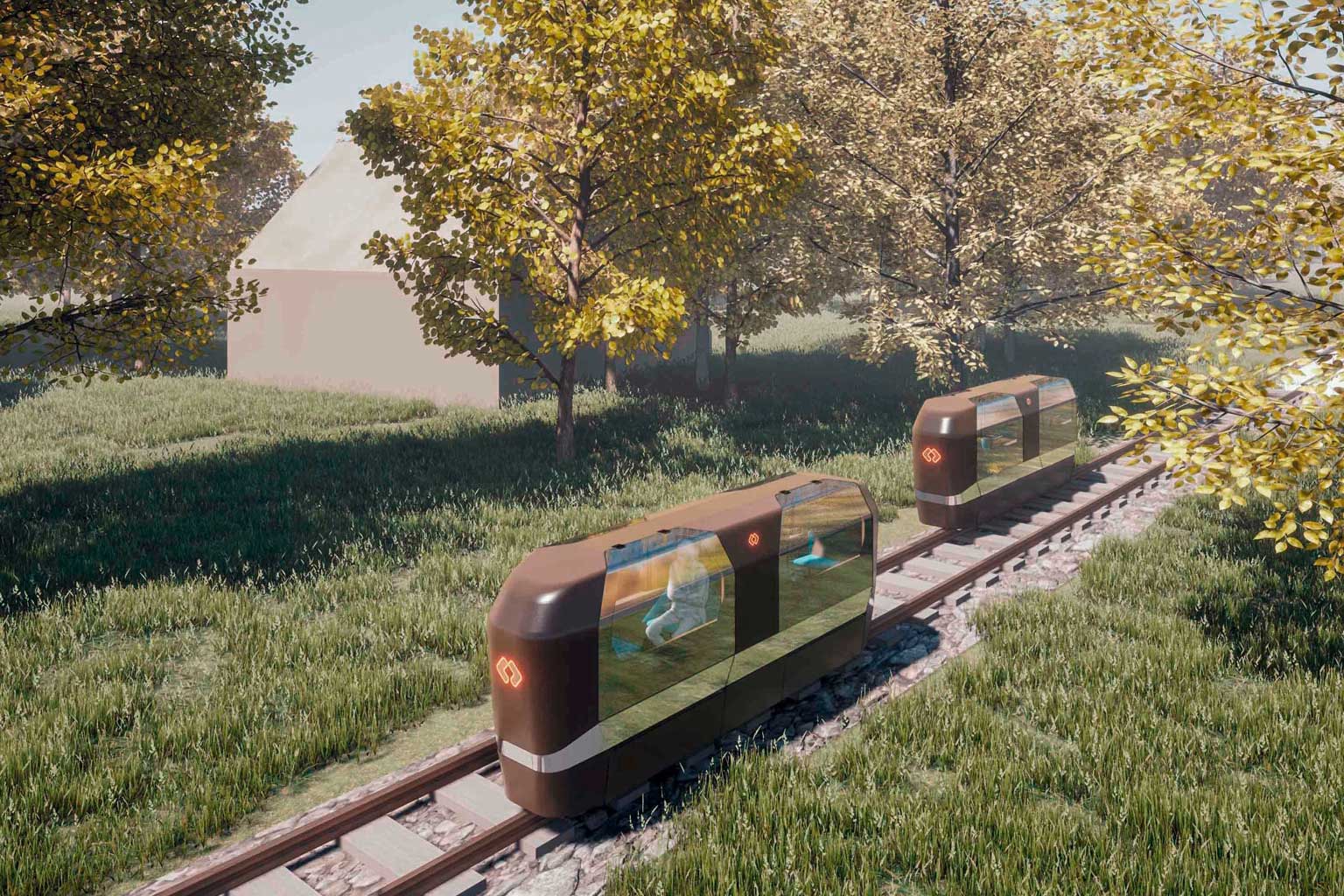
MONOCABs are compact, gyroscopically stabilized, and autonomously operating single-rail vehicles that can travel bidirectionally on a single track. They support autonomous and connected mobility in public transport within polycentric and rural regions by cost-effectively reactivating disused railway lines and thereby providing a flexible and innovative mode of transport. The vehicles can transport up to six passengers barrier-free, operate battery-electrically at speeds of up to 60 km/h, and require only minimal infrastructure.
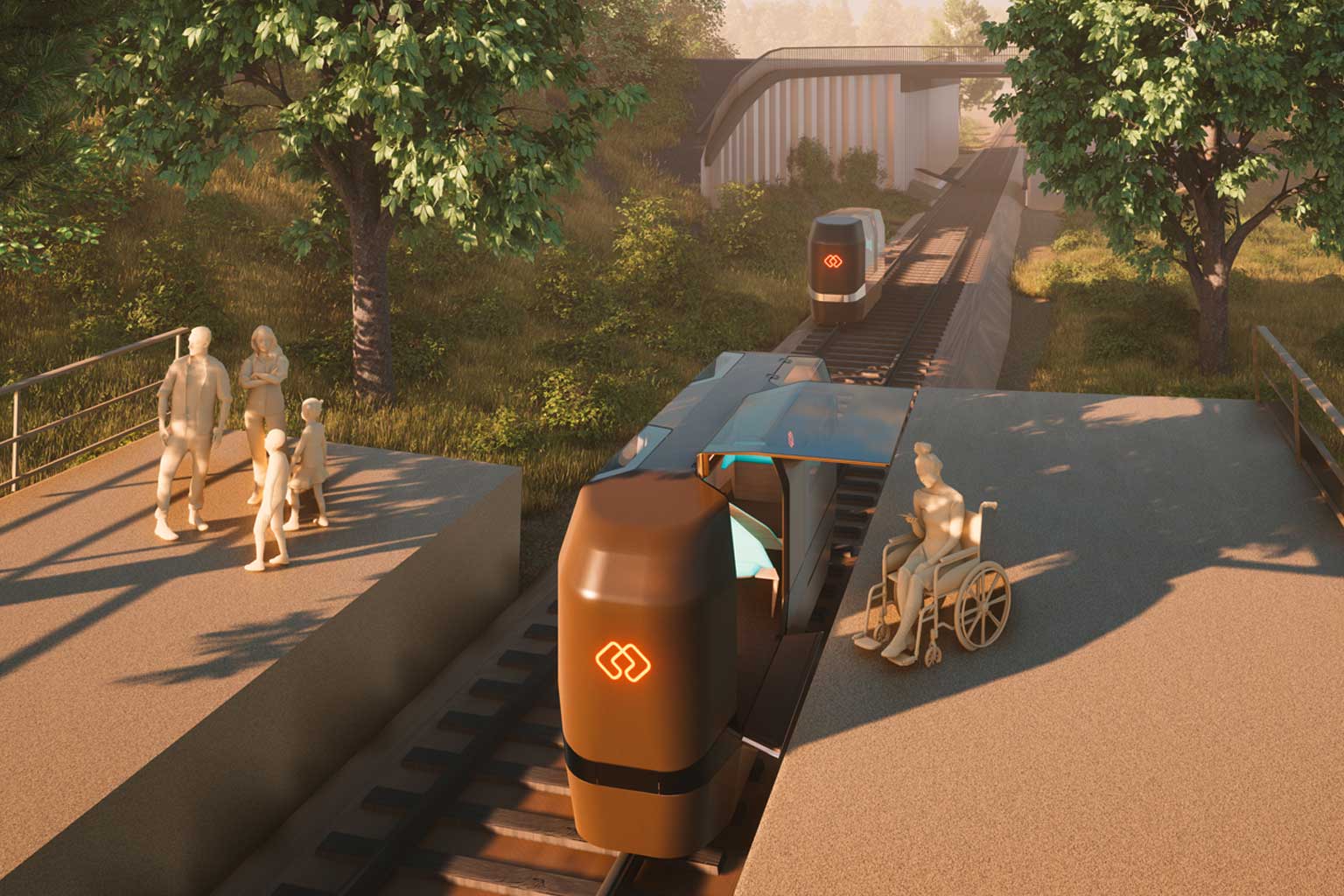
In addition to the cost-effective reactivation of old railway lines, the MONOCAB system enables innovative and economical neighborhood, campus, or urban railway solutions and is also conceivable for freight transport. Combined with an on-demand operating concept, MONOCAB represents a demand-oriented and user-friendly transport system that can be operated efficiently even with low passenger volumes. In this way, MONOCAB supports the transformation of mobility, particularly in rural areas, toward a sustainable overall transport system.
The idea behind MONOCAB originated from voluntary civic engagement and was awarded the German Mobility Award Open Innovation in 2018. Today, under the leadership of Technische Hochschule Ostwestfalen-Lippe, the concept is being further developed together with partners from Bielefeld University of Applied Sciences and Fraunhofer IOSB-INA into an innovation not only for rural areas but also as a model for “Individual Public Transport (IPT).”
Data and Facts
The MONOCAB initiative is being advanced through several research projects. The core partnership consists of Technische Hochschule Ostwestfalen-Lippe as consortium leader, Bielefeld University of Applied Sciences, and Fraunhofer IOSB-INA. In addition, the research projects integrate partners from industry, research, and society.
Research Budget
MONOCAB OWL (completed project, approx. EUR 4 million, funded by: ERDF + Ministry for the Environment of North Rhine-Westphalia)
MONOCAB Key Technologies (ongoing project, approx. EUR 5 million, funded by: ERDF + Ministry for the Environment of North Rhine-Westphalia)
Campus Railway at Innovation Campus Lemgo (ongoing project, approx. EUR 1 million, funded by: ERDF + Ministry for the Environment of North Rhine-Westphalia)
enableATO (ongoing project, MONOCAB share included, total project volume: approx. EUR 12 million, funded by: Federal Ministry for Digital and Transport)
MONOCAB ready (ongoing project, approx. EUR 7 million, funded by: Federal Ministry for Digital and Transport)
Project Duration
MONOCAB OWL (09/2020 – 06/2023)
MONOCAB Key Technologies (06/2024 – 11/2026)
Campus Railway at Innovation Campus Lemgo (01/2024 – 12/2026)
enableATO (01/2024 – 12/2026)
MONOCAB ready (11/2024 – 12/2026)
Contact Persons
Thorsten Försterling
– Public Relations –
tf@monocab-owl.de, P 0173 62 080 45
Martin Griese
– Transfer Manager –
martin.griese@th-owl.de, P 05261 702-5106
Fabian Kottmeier
– Project Coordinator –
fabian.kottmeier@th-owl.de, P 05261 702-5302
Prof. Dr.-Ing. Thomas Schulte
– Project Manager –
thomas.schulte@th-owl.de, P 05261 702-5828
Project Website
Social-Media
Youtube: https://www.youtube.com/@monocabowl
LinkedIn: https://de.linkedin.com/company/monocab-owl
Facebook: https://www.facebook.com/monocabowl
Instagram: https://www.instagram.com/monocabowl/
Wikipedia: https://de.wikipedia.org/wiki/Monocab
The MONOCAB ready project is funded by: