TestingATO – Innovation Laboratory for Automated Driving in Rail Transport
Background & Motivation
Rail transport is a key component of a sustainable, efficient, and future-oriented transportation system in Europe. In order to meet increasing demands regarding capacity, quality, and climate protection, automation is becoming increasingly important.
Automated and autonomous driving (ATO) is a major lever for:
- Higher operational efficiency
- Improved utilization of infrastructure
- Greater reliability and safety
The development and implementation of these technologies require a specialized testing environment. In particular, suitable realistic yet controllable test conditions for perception systems — including sensor technology and environmental perception — are currently lacking.

Project Objective
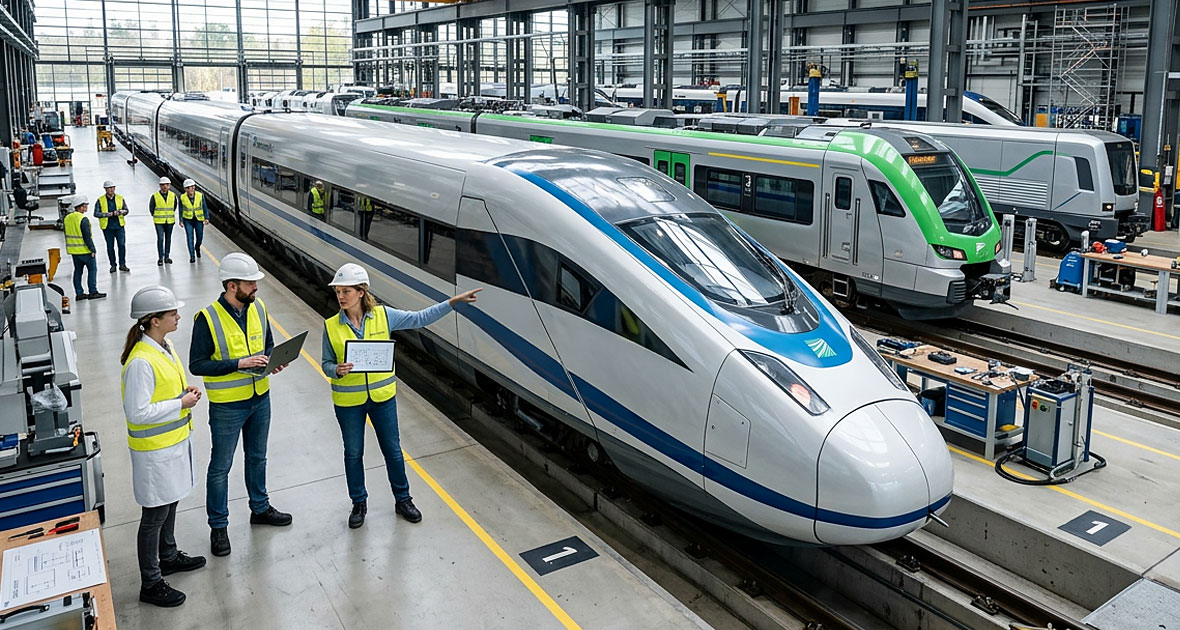
The aim of the project is to establish a dual-track ATO innovation laboratory at the site of DB Systemtechnik GmbH in Minden.
The main focus areas are:
- Research and development of ATO system technologies
- Testing under realistic operating conditions
- Support for approval and certification processes
- Development of standards for ATO components
At the core of the infrastructure is a dual-track testing and validation facility that:
- Enables reproducible testing
- Provides controllable environmental and weather conditions
- Simulates real operational scenarios
A particular focus is placed on the validation of perception systems, which play a key role in safe automated driving.
Added Value of the Test Infrastructure
The innovation laboratory creates significant benefits for both research and industry:
- Relocation of tests from live railway operations into a laboratory environment
- Relief for the highly utilized rail network
- Acceleration of development and approval processes
- Improved comparability of test results
- Increased safety during system development
Implementation
he implementation of the innovation laboratory is carried out in several consecutive phases.
During the initial phase, the fundamental framework conditions are defined. Building upon this, the planning phase includes the preparation of all necessary approval and construction documents as well as the design of the research and testing infrastructure, which serves as the basis for procurement activities.
This is followed by the tendering and awarding of construction contracts and the procurement of the required testing systems. During the construction phase, the structural measures are implemented and supervised, while the testing systems are developed, installed, and integrated into the infrastructure in parallel.
The project concludes with the final acceptance and commissioning of the innovation laboratory.
Project Duration
01 October 2025 – 31 December 2027
Project Partners