DiBaMi – Digital Railway Station Minden
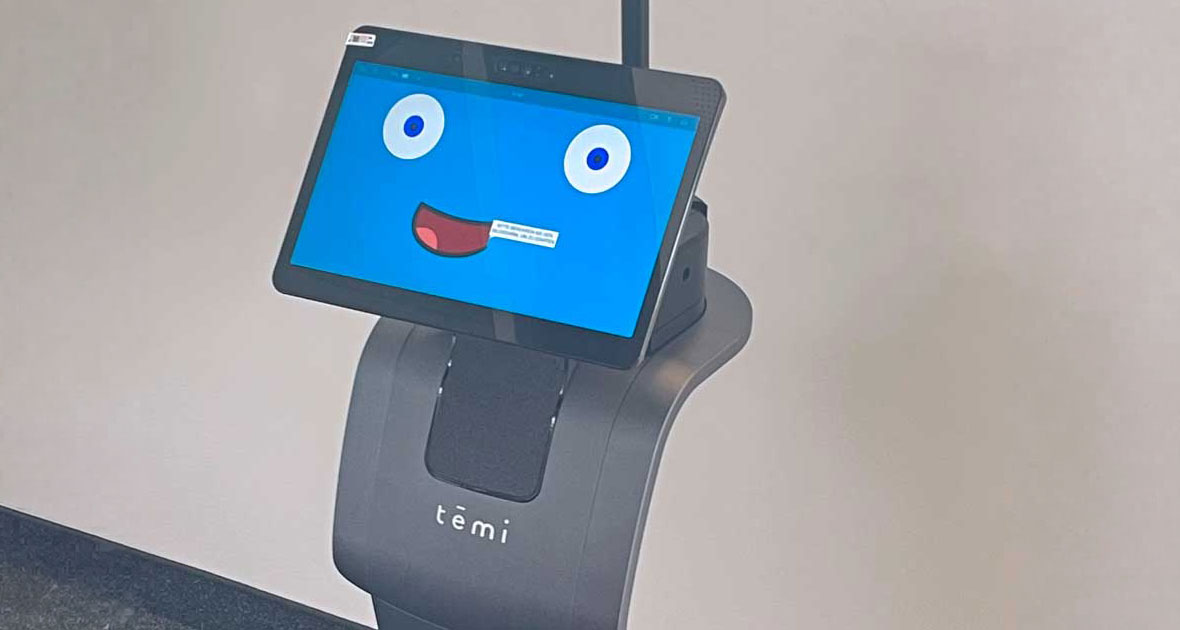
DiBaMi – Digital Railway Station Minden is a project in which measures are being developed to ensure seamless mobility flows and a pleasant stay at the railway station. Service robots support passengers with luggage transport, provide information, and enhance passenger safety, particularly at smaller railway stations.
Realization of the Project
The DiBaMi project develops measures for smooth traffic flow and an enjoyable station experience. In the future showcase railway station, information and assistance robots will support passengers. The project consists of four subprojects:
1. Service Robots
At Minden railway station, the development and testing of service robots will be particularly visible. These robots are intended to make boarding and alighting easier for elderly passengers and passengers with reduced mobility by providing information about connecting services and other modes of transport, accompanying passengers to the next station within the mobility chain — such as a bus stop — and assisting with luggage transport.
At less frequented railway stations, the robots can also improve safety, as they are equipped with emergency call buttons.
2. Robot Monitoring
In another subproject, implemented by Paderborn University and Bielefeld University, methods are being developed to automatically monitor the condition of the robot and enable the machine to adapt its behavior when, for example, the battery level becomes low.
Possible operational and environmental conditions at the railway station are also taken into account. The aim is to enable energy-efficient and robust operation.
3. Showcase Mobility Hub Minden Railway Station
Within the subproject “Showcase Mobility Hub Minden Railway Station,” researchers identify and test additional use cases. For this purpose, innovation scouts are being trained to advance new solutions for sustainable mobility.
Visitors are surveyed in studies related to the digital railway station. The results are integrated into courses at the four participating universities. The railway station is intended to develop into a “third place” for collaboration and extracurricular learning.
An online portal supports this process and is complemented by dialogue formats in which citizens discuss their mobility needs and the new mobility services.
4. Communication Network
Another subproject develops the technical communication network for the robots and the showcase railway station. For this purpose, the 4G/5G network of a telecommunications provider is being utilized.
Only through this infrastructure is it possible, for example, to monitor a robot’s operational status and position in real time.

Data and Facts
The research is part of the RailCampus OWL network: Bielefeld University leads the project in cooperation with Technische Hochschule Ostwestfalen-Lippe, Bielefeld University of Applied Sciences, and Paderborn University.
The project is funded within the framework of the EFRE/JTF Programme NRW, REGIONALE Ostwestfalen-Lippe: Connected Mobility and Digital Applications. The State of North Rhine-Westphalia is funding the project with EUR 1.2 million.
Project Duration
01 March 2024 – 28 February 2027
Contact Person
PD Dr.-Ing. Sven Wachsmuth
CITEC | Universität Bielefeld
sven.wachsmuth@uni-bielefeld.de
More Information About the Project
PD Dr.-Ing. Sven Wachsmuth
CITEC | Universität Bielefeld
sven.wachsmuth@uni-bielefeld.de

