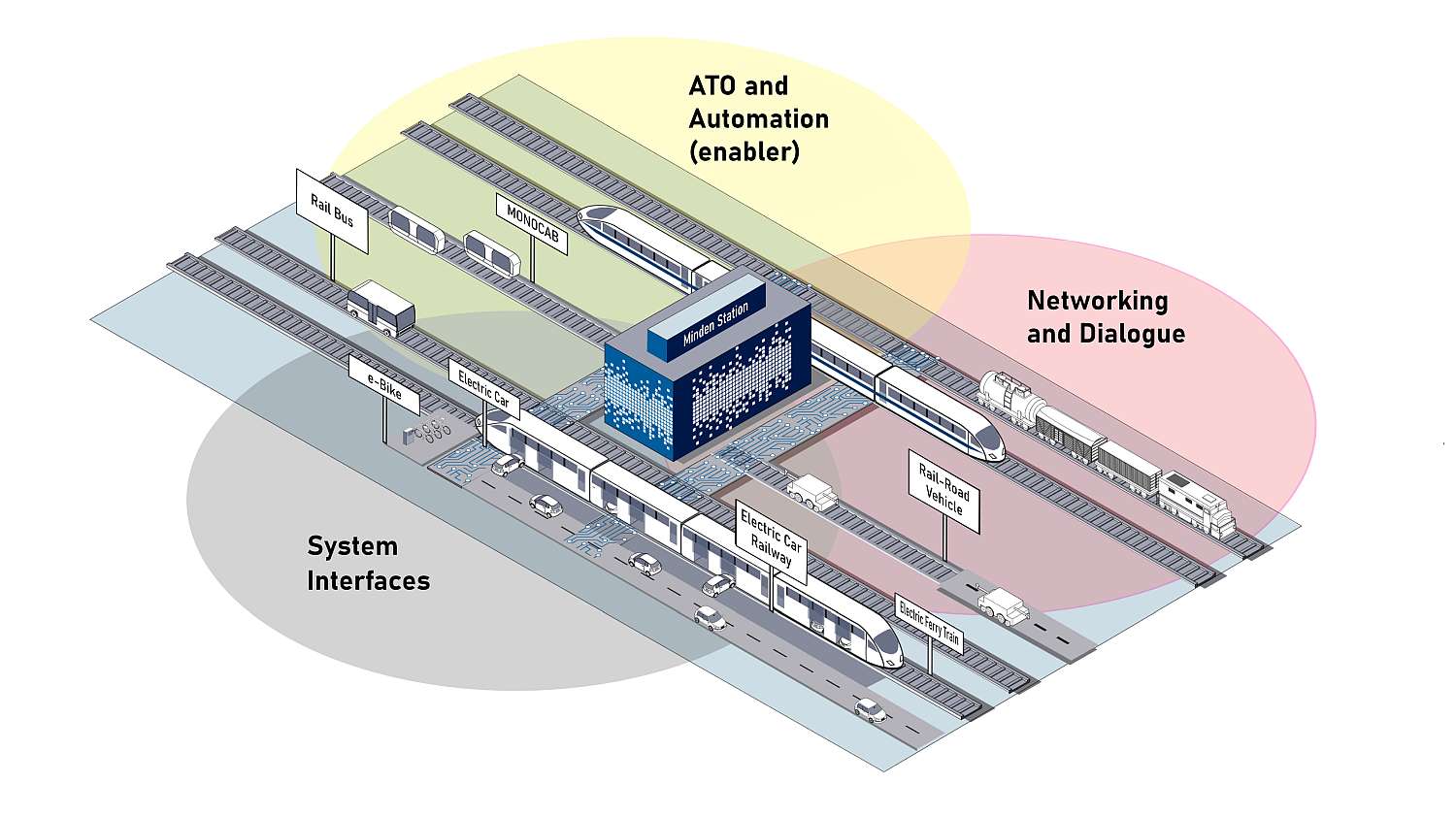
The enableATO Project
The goal of the enableATO project is to enable modern concepts for automated rail mobility and to investigate them through new rail-based approaches in rural areas.
Project Implementation
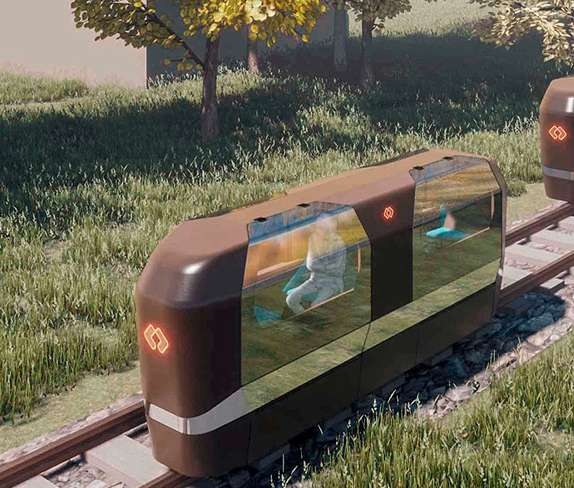
To achieve this, the required technologies and framework conditions must be developed to a level that allows a demonstration using a fully automated, driverless light rail vehicle such as the MONOCAB.
The project initially focuses on small, newly developed vehicles operating automatically on existing railway tracks in rural regions. Research and development activities primarily concentrate on technologies capable of taking over tasks currently performed by train personnel. These include:

- The perception of situations during operation as well as boarding and alighting processes through sensor systems, enabling intelligent control operations such as departure, driving, warning generation, and stopping
- The localization of vehicles on a route and communication with a control center in order to integrate them into operational concepts and execute driving commands
- Safety measures such as interior monitoring, analysis of situations inside the vehicle and at the platform, combined with communication capabilities to a control center and consideration of security requirements
- The enablement of intelligent predictive maintenance through early detection of system changes within the vehicle, combined with digital twins
- The integration of technical solutions into vehicles such as the MONOCAB or dual-mode road-rail vehicles in order to test and demonstrate the developed core technologies and concepts within the project at the Minden site or in the Extertal in the region of Ostwestfalen-Lippe in Germany
In addition to the purely technical aspects, further topics are being investigated:
- The development of framework conditions required for approval and legal implementation of the described approaches
- The extent to which user acceptance can be achieved, including science dialogue activities with society
- Opportunities for networking other transport modes with the rail system, such as linking small electric vehicles with rail transport
Project Duration: 01 January 2024 – 31 December 2026
Funding Volume: €12.5 million
The Overall enableATO Project Consists of 5 Subprojects
The objective of enableATO is to enable modern concepts for automated rail mobility and to investigate them through new rail-based approaches in rural areas. The overall project is divided into five subprojects:
- Project Management, Administration and DZM Networking
- ATO Enabling Technologies
- Legal Framework Conditions and Approval
- Concept Demonstration
- User Acceptance and Science Dialogue
Further information on the subprojects is available separately.
The Partners in the enableATO Project
The project consortium consists of renowned partners. Together, they contribute extensive expertise and many years of experience to advance the vision of sustainable, connected, and automated mobility in rural areas.

The University of Bielefeld combines interdisciplinary basic research in Cognitive Interaction Technology at CITEC, focusing on the development of intuitive technical systems. As CITEC’s innovation laboratory for human-centered automation, the CoR-Lab uses these findings and methods together with external industry partners to develop application-oriented cognitive systems and to align machine learning technologies accordingly.

Wölfel Engineering GmbH + Co. KG is a technology-oriented medium-sized engineering company specializing in vibration engineering, acoustics, and structural mechanics. The company provides engineering services and monitoring and vibration reduction systems. Within enableATO, Wölfel Engineering investigates condition and performance indicators based on vibration measurement data to enable continuous monitoring and condition-based maintenance of rail vehicles. This expertise contributes to increased operational safety and reduced costs.

The University of Paderborn is one of Germany’s medium-sized universities with strong research and transfer activities. Researchers work on the technologies of the future while always considering societal requirements. The development of sustainable solutions for the pressing challenges of our time shapes research activities at the University of Paderborn.

The HARTING Technology Group is a global leading provider of industrial connectivity technology. The company focuses on the three lifelines of an electrified and digital world: data, signal, and power.

Bielefeld University of Applied Sciences and Arts (HSBI) contributes extensive expertise and experience in transferring research results into practical applications. The Institute for System Dynamics and Mechatronics (ISyM) has the capability to prototype intelligent systems as technical artifacts and make them accessible for commercial exploitation by companies.

Pilz GmbH & Co. KG – a leading global supplier of components, systems, and services under the guiding principle “The Spirit of Safety” – provides the PSSrail platform for safe railway applications worldwide.
Ostwestfalen-Lippe University of Applied Sciences and Arts (TH OWL) contributes its recognized expertise in automated driving, safety and security, vehicle and system development (MONOCAB), and science communication to the project.

The Fraunhofer Institute for Mechatronic Systems Design (IEM) provides expertise in intelligent mechatronics in the context of Industry 4.0. Core competencies include intelligence in mechatronic systems, systems engineering and software engineering, virtual prototyping and simulation, industrial data science, and control engineering.

Fraunhofer IOSB-INA contributes its expertise in machine safety and the approval and assessment of new technologies. A safety concept for automated/autonomous driving is being developed, and the project development is supported with regard to functional safety. Furthermore, the framework conditions for approval in combination with the MONOCAB concept demonstrator are being analyzed and approval processes are being prepared.

As Europe’s largest competence center for railway technology, DB Systemtechnik GmbH provides engineering and testing services for the entire railway sector. Around 1,100 employees work in Germany and worldwide to shape the rail transport of tomorrow through technical and digital railway expertise.

RailCampus OWL in Minden is a center for research, development, and knowledge transfer as well as for academic studies and professional training with a focus on rail-based mobility. RailCampus serves as the central point of contact for the entire enableATO project.